Resource Guide • Emergency Response
What to Do in the First 24 Hours After Water Damage
The first day after discovering water damage is about protecting people, preserving safe documentation, and arranging qualified help — not about performing hazardous cleanup yourself. The most important immediate decision is whether the area is safe to enter. Standing water near electrical fixtures, sagging ceilings, unstable floors, suspected sewage, and exterior floodwater all present hazards that untrained occupants should not approach. From a safe location, you can note what happened, communicate with the right property contact, document visible conditions with photographs, and arrange a qualified professional assessment. The "first 24 hours" is an organizing guide for responsible action — it is not a guaranteed mold-free window, a promise that this business will respond within a day, or a substitute for emergency services when life safety is at risk.
The problem
First decision: is it safe?
- Water near electrical fixtures, outlets, or panels — electrocution risk
- Sagging ceilings or bulging drywall — collapse risk
- Unstable, buckling, or saturated floors — fall-through risk
- Suspected sewage, drain backup, or floodwater — contamination risk
- Gas odor or damaged gas lines — explosion risk
- Restricted or unknown access (crawl spaces, attics) — confined-space risk
Process
Responsible first-day workflow
A safety-first sequence for the hours after water damage is discovered.
Confirm safety before entering
Visually assess from a dry, safe vantage point. If water is near electrical panels, outlets, or fixtures, do not enter. If a ceiling is sagging or a floor feels unstable, stay out. For gas odors or suspected sewage, leave the building and contact the utility or emergency number.Note the situation from a safe location
Record the approximate discovery time, which rooms are affected, whether water is visible or only damp, whether the source appears active, and any access restrictions. For rental or commercial property, note management and authorization requirements.Communicate with the correct contact
Notify the property owner, manager, or insurer through the established channel. For rentals, use the lease or management reporting process. For owners, contact your insurance agent or carrier. Do not enter another unit or force access to shared utility systems.Document visible conditions safely
Take photographs and short video from safe, dry areas. Capture the water source (if visible), affected rooms, damaged materials, and standing water. Do not delay urgent hazard response only to photograph, and do not enter unsafe areas for a better angle.Arrange qualified professional assessment
Contact a qualified restoration provider for moisture mapping, source evaluation, and a written scope. Source repair may require a separate licensed plumber, roofer, or HVAC technician. An assessment inquiry is not a guarantee of same-day arrival or dispatch.
Materials & scope
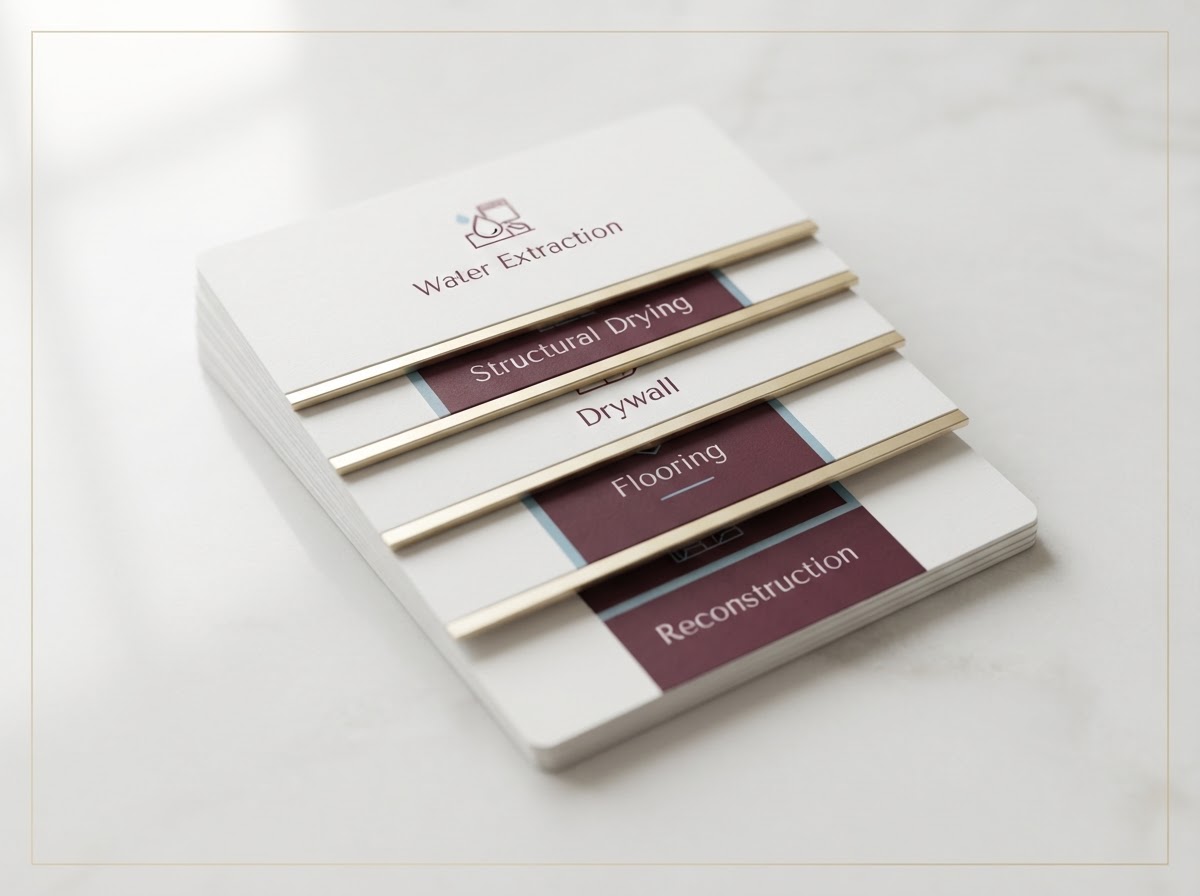
What qualified restoration may involve
Possible stages a qualified professional may follow, depending on findings — not a guaranteed sequence for every loss.
- Source identification and repair
- A licensed plumber, roofer, or HVAC technician addresses the active water source. Stopping the source is separate from drying the materials it wetted.
- Water-condition assessment
- A restoration professional evaluates the water category and drying class, screens for contamination, and documents findings. This assessment drives safety controls and drying strategy.
- Extraction where appropriate
- Standing water is removed with appropriate extraction equipment. Visible water removal does not prove concealed materials are dry — moisture may remain in cavities, insulation, and subfloors.
- Building-material evaluation
- Porous materials (drywall, insulation, carpet, pad) are evaluated for moisture content and contamination. Some materials can be dried; others may require removal and replacement based on category and condition.
- Controlled drying and monitoring
- Air movers, dehumidifiers, and moisture monitoring are used to return materials to a dry standard. Drying time depends on the water source, materials, exposure, contamination, and access — not a fixed clock.
- Reconstruction if required
- Replacement of drywall, flooring, insulation, or structural elements may require a separate licensed contractor and local permits. Reconstruction is a separate scope from mitigation and drying.
Frequently asked questions
Official Sources & Further Reading
Last reviewed: 2026-11-02Educational guidance compiled for Alabama property owners. Review individual policy contracts, statutory codes, or relevant official agency documentation for specific coverage or legal questions.
- CDC — Returning Home After a Natural Disaster →U.S. Centers for Disease Control and PreventionOfficial safety guidance for re-entering property after flooding or water damage.
- EPA — Mold, Moisture and Your Home →U.S. Environmental Protection AgencyPublic guidance on moisture control and mold prevention relevant to first-day response.
- ANSI/IICRC S500 Standard Overview →IICRCProfessional water damage restoration standard that informs responsible first-day scope.
Next steps
Related restoration topics
Live pages with related guidance for Dothan-area property owners.
Need a safe, qualified assessment?
Request a professional restoration assessment for your Dothan or Wiregrass property. We can help coordinate moisture evaluation, source documentation, and a written scope from appropriately qualified providers.