Wiregrass • Moisture Control
Structural Drying and Dehumidification in Dothan, AL
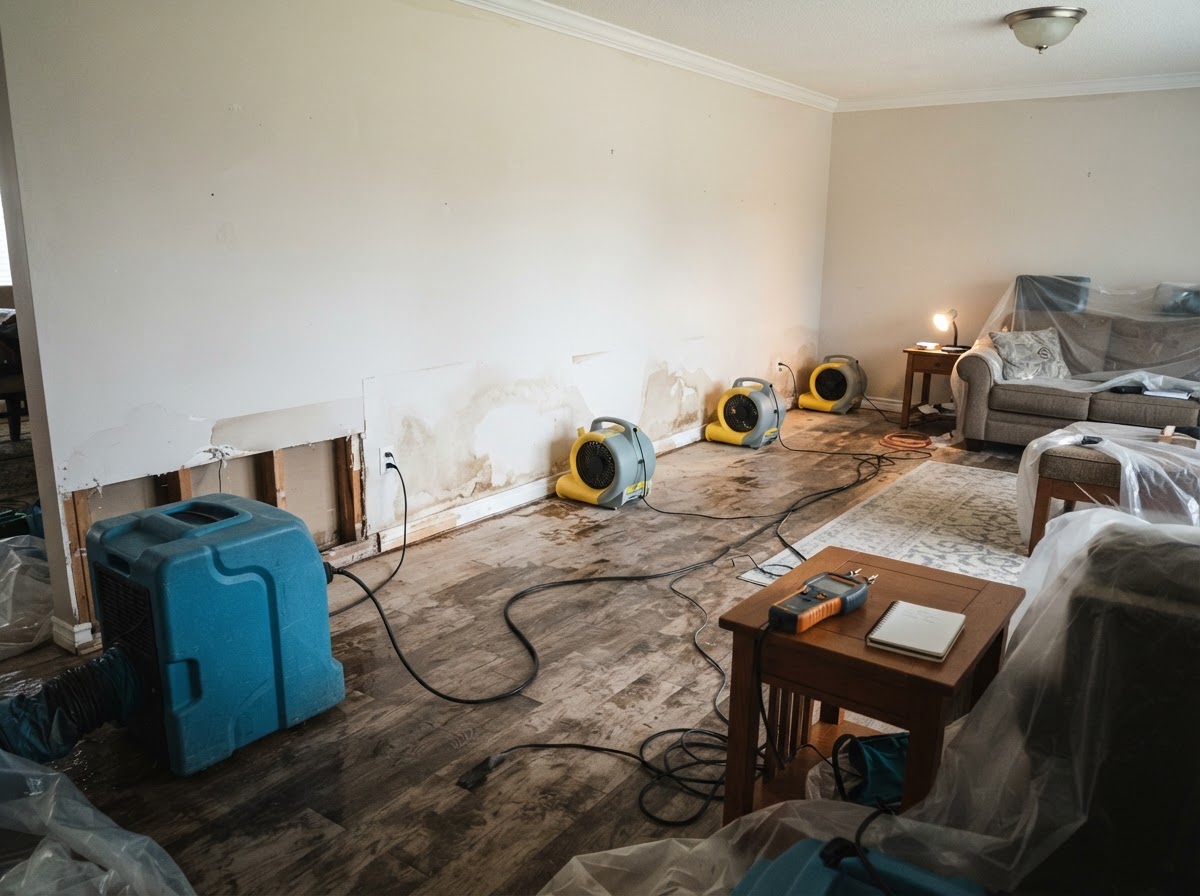
A room can look completely dry on the surface while wall cavities, subflooring, insulation, or framing members are still holding moisture from a leak or flood. Structural drying is the controlled process of driving that trapped moisture out of materials and confirming, with measurements rather than appearance, that a building is actually dry. This assessment is an inquiry — it is not a guaranteed drying timeline or a promise that every material can be saved in place.
The problem
Why a dry-looking room can still be wet inside
- Wet drywall and insulation that wicks and holds moisture
- Saturated subflooring beneath intact flooring
- Damp framing cavities and stud walls
- Cabinetry with moisture trapped in backs and toe kicks
- Concrete slabs that release moisture slowly
- Carpet and pad that hold water beneath a drier surface
- Elevated indoor humidity from wet materials
Process
From trapped moisture to a documented, dry condition
A general sequence for controlled structural drying. The actual steps, equipment, and duration depend on the materials involved, the amount of moisture, and the qualified provider's findings.
Professional safety and source assessment
Before drying begins, the area is checked for electrical, structural, or contamination hazards, and the water source is confirmed stopped or isolated by the appropriate party.Establish a moisture baseline
Using moisture meters and hygrometers where appropriate, a qualified provider records starting conditions in affected and unaffected areas for comparison.Evaluate affected materials and extent
The inspection looks beyond the surface — behind walls, under flooring, and into cavities — to determine how far moisture has traveled and which materials can be dried versus removed.Remove standing water and unsalvageable materials first
Extraction and removal of saturated or contaminated materials come before drying, so drying is not wasted on materials that cannot be saved.Apply controlled air movement and dehumidification
Where justified, air movers and dehumidifiers manage airflow and remove evaporated moisture from the air. No universal equipment count, temperature, or humidity setpoint is prescribed here.Monitor readings, adjust, and document completion
Periodic moisture readings track progress toward target conditions determined by the qualified provider, who documents when the structure is dry rather than applying a fixed timetable.
Materials & scope
What dries, what may not, and what changes the plan
Material type, water category, access, and occupancy all change the drying approach. Some materials are candidates for in-place drying; others are removed because they cannot be reliably dried or because contamination makes drying inappropriate.
- Drywall & insulation
- Drywall can sometimes be dried if contamination is low and structural integrity remains; insulation that has absorbed water often loses effectiveness and is removed.
- Wood flooring & subfloor
- Hardwood and engineered floors may cup or crown; the subfloor beneath must also be assessed, since a dry surface does not prove the layers below are dry.
- Concrete & slab interfaces
- Concrete releases moisture slowly and can influence flooring adhesives; readings over time help confirm when it has reached an appropriate condition.
- Ceiling assemblies
- Water can travel along framing and collect in ceiling cavities far from the visible source, requiring inspection above and beyond the obvious stain.
- Cabinets
- Moisture can wick into cabinet backs and toe kicks where airflow does not reach, sometimes requiring limited removal or access panels to dry the space behind.
- Occupied & commercial spaces
- Drying equipment adds noise, power draw, and traffic considerations; occupied homes, rentals, and businesses require coordination of access, containment, and belongings.
Frequently asked questions
Next steps
Related restoration topics
Live pages with related guidance for Dothan-area property owners.
Describe the moisture situation and request an assessment
Share the suspected source, when it was discovered, the materials affected, whether any visible water remains, and the property location. The inquiry is reviewed — it is not a confirmed drying schedule, dispatch, or service acceptance.